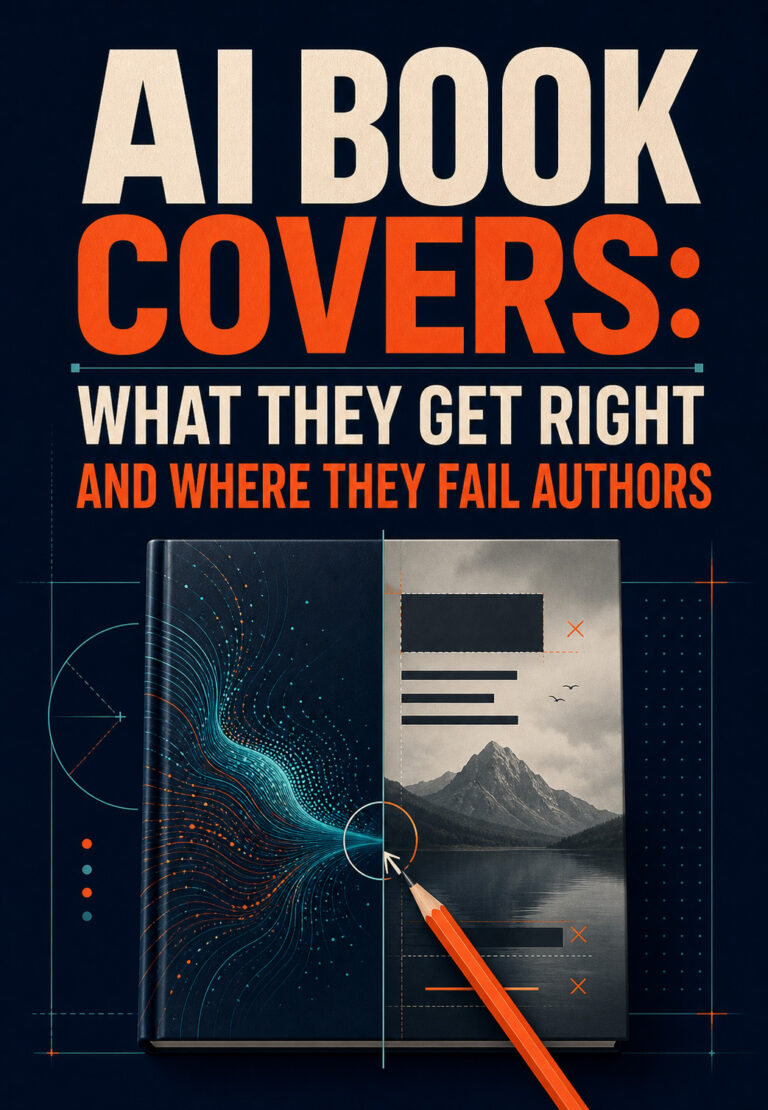
Every week an author tells me some version of the same story: “I made a cover with AI and it looked amazing… until I put it next to the bestsellers in my category.” As a professional book designer, I’m not going to pretend AI book covers don’t exist or that they never look good. Some look startlingly good. But looking good and selling books are different jobs, so here’s an honest accounting of both sides, from someone the technology is supposedly replacing.
What AI Genuinely Does Well
Let’s give credit where it’s due, AI book covers earn their popularity honestly in one area, exploration. AI generators are extraordinary brainstorming tools. In ten minutes you can explore forty moods for your book such as lighting, palettes and atmospheres that would have taken days of stock-photo hunting. For concepting, vision boards, and communicating “something like this” to a designer, they’re brilliant.
They’ve also raised the floor. The truly terrible DIY cover, Comic Sans over a vacation photo, is going extinct, because AI output at its worst is still competent-looking imagery.
Where AI Book Covers Quietly Fail
The problems start where readers can’t articulate them but absolutely feel them.
Genre positioning. AI knows what a fantasy cover looks like in general. It doesn’t know what’s on the current top-50 shelf in your subgenre, which visual clichés are exhausted, or which comp titles your reader already bought. A cover’s job is to say “if you liked that, you’ll like this”, and that’s market research, not image generation.
Typography. This is the big one. Title typography does most of a cover’s selling, and it’s exactly what AI handles worst, mangled letterforms, generic font choices, text that disintegrates at thumbnail size. Even when authors add their own type over an AI image, the composition wasn’t designed to hold it, so the title fights the artwork instead of riding it.
The details that get you rejected or reviewed. Six fingers still happen. So do impossible lighting, melted background faces, and, more practically, files with no bleed, wrong trim, RGB-only color, and no spine. Amazon KDP doesn’t care how the image was made; it cares whether the print file is right. And a growing number of readers actively check reviews and forums for AI-generated covers before buying, especially in romance and fantasy communities.
Rights. Commercial-use terms vary between AI platforms and are still legally unsettled. When your book takes off, “probably fine” is not where you want your cover’s licensing to be.
Quick gut-check: Is your AI cover ready to publish?
Before you upload, run three tests. First, the thumbnail test: shrink your cover to the size it appears in Amazon search results and line it up beside the current top ten in your category, most AI book covers fail here first, because they were judged at full-screen size. Second, the typography test: zoom into your title. If the letterforms warp, blur, or crowd the artwork, readers will register it even if they can’t name it. Third, the rights test: find the actual commercial-use terms for the generator you used and save a copy. If you can’t confidently explain who owns your cover, that’s your answer.
Pass all three and publish without guilt. Fail any one, and you’ve found exactly where a professional earns their fee — often by building on the AI concept you already love.
The Hybrid Truth
Here’s what nobody selling either side tells you: the future is already hybrid. Professional designers are now using AI the way they’ve always used mood boards and stock libraries: as raw material, feeding a process that still runs on genre research, composition, licensed typography, and print production. The question was never “AI book covers or a designer.” It’s whether anyone with market judgment is steering.
So use AI freely for exploration. But before you publish with a raw AI book cover, put it at thumbnail size next to the top ten books in your category and ask honestly: does mine look like it belongs? If the answer is no, or you’re not sure, that’s the gap a professional closes. I wrote more about what actually makes covers sell in What Makes a Book Cover Sell?, and if you want an expert set of eyes on your cover, AI-made or otherwise, schedule a free consultation and I’ll tell you the truth about whether AI book covers are costing you clicks.”